
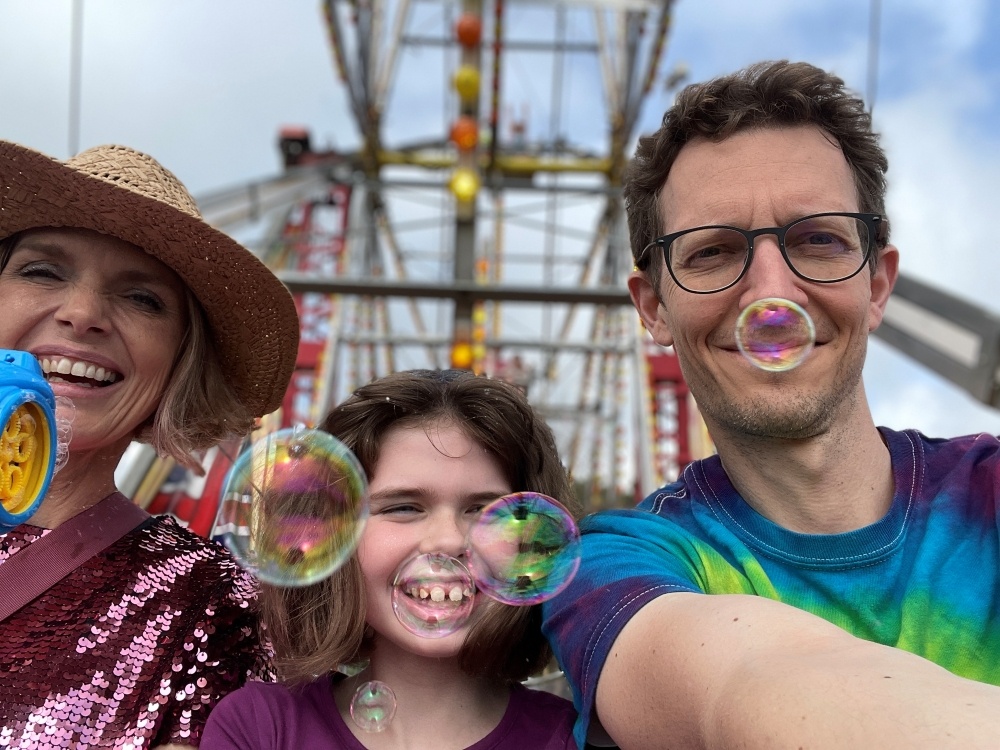
When Mathilde was just eight weeks old, something changed.
Up until that point, she’d been healthy and feeding well. Then, almost overnight, she stopped wanting to eat. All she would do was cry. Feeding became a daily battle for her parents, one that grew more desperate with every passing week.
“It was very strange and alarming,” mum Lizzy recalls. “We tried all sorts of devious ways to give her food. Spinning in a chair, feeding her while she slept, putting her in the car seat, white noise, dark rooms. We even kept a blackboard on the back of the door and marked down every feed. One day we reached 30 feeds and 30 ounces, so she was eating enough, but the effort was insane.”
It was clear something wasn’t right. But no one could say what.
Searching the world for answers
What followed was a journey that took Mathilde and her family across continents. Living in China at the time, they saw specialists in Hong Kong, Vietnam and Thailand. They were told it might be psychological. That the bond between mother and child was disrupted. That Mathilde would learn to feed eventually.
“I thought it was my fault,” says Lizzy. “So for three months, only my husband and our nanny fed her. But nothing changed. Then we switched formula and that helped, but only for a short time.”
Mathilde continued to lose weight. Eventually, the family travelled to London, where doctors at the Portland Hospital recommended a gastrostomy tube to keep her nourished. What was intended as a temporary measure became permanent. Today, 14 years later, Mathilde relies on that tube.
For years, the focus remained on feeding. Gastroenterology appointments. Tube-weaning programmes. Clinics across Europe and the US. Each promised hope, but couldn’t deliver any answers.
“Everyone kept telling us that she just had to learn to swallow, or have a sensory diet, or go to this feeding clinic or that feeding clinic,” Lizzy says. “But the tube isn’t the problem. The tube is our friend. It’s the thing that’s kept her alive.”
“We’ve seen all the ‘ologists’ and not one could give us a concrete answer. We always assumed that if there was a problem, there would be a solution,” she continues. “It never occurred to us that this might be something innate. Something that couldn’t be fixed.”
When symptoms don’t tell the whole story
As Mathilde grew, other symptoms appeared. Changes in her walking. Episodes of severe vomiting. Visual and neurological difficulties. Each was treated separately, resulting in a growing list of diagnoses: Avoidant/Restrictive Food Intake Disorder (ARFID), autistic traits, cyclical vomiting, cerebral palsy…
“What we were seeing were the manifestations,” Lizzy says, “but not the cause. In a way, we were chasing a false flag by concentrating on the feeding tube when we should have been focusing more on neurology.”
For a long time, genetics testing offered no answers either. Earlier tests came back inconclusive. The science simply wasn’t there yet.
Then, a few years later, things changed.
New research had identified genetic variants that weren’t previously understood. Mathilde underwent further testing, and at last, there was a unifying explanation: a variant of unknown significance in the PYCR2 gene affecting mitochondrial function.
“It was shocking,” Lizzy says. “We’d resigned ourselves to never knowing. But suddenly, all these separate diagnoses made sense as part of one condition.”
The power of precision diagnostics
That diagnosis changed everything. It allowed professionals to understand Mathilde’s needs more clearly. It unlocked access to specialist support. And it connected the family to a wider mitochondrial disease community, including The Lily Foundation.
Through that connection, Mathilde became part of the Precision Diagnostics Study, a Lily-funded initiative designed to help families like hers get answers sooner. The project combines the latest advances in genetic science and data analysis with a high level of clinical expertise. For complex conditions like mitochondrial disease, this approach can potentially reveal genetic changes that routine NHS testing might miss.
“Being part of this project isn’t about finding a cure tomorrow,” Lizzy explains. “It’s about gaining a greater understanding of her condition today. About tailoring support. About focusing on quality of life instead of endlessly chasing answers that don’t exist.”
Why this matters beyond one family
Mathilde’s variant is rare, even among rare diseases. But her story isn’t.
“There must be so many children out there with ‘question mark’ diagnoses,” Lizzy says. “Question mark cerebral palsy. Question mark feeding disorder. The more genetic information we can gather, the more it can help others.”
Precision diagnostics don’t just help individual families. They reduce repeated testing, shorten diagnostic odysseys and help clinicians recognise patterns earlier. They allow care to be co-ordinated, rather than fragmented. And they ensure that children are looked after for who they are, not just treated for isolated symptoms.
Today, Mathilde is supported by a joined-up NHS team that includes genetics, neurology, gastroenterology, psychology, community paediatrics, occupational therapy, speech and language therapy and vision specialists. That collaboration exists because her condition is now understood and she’s had continuity of care for the last seven years.
“We’ve come full circle,” Lizzy says, “and I’m very glad it’s the UK that’s pioneering this. We deliberately moved to Bristol because we knew it was a centre of medical excellence and has a fantastic children’s infirmary. After travelling the world for answers, we finally found them back home.”
Looking forward, one day at a time
The future remains uncertain. Mathilde’s condition is complex, and symptoms can flare up without warning. But her family now have knowledge, support and community.
“We take it day by day. I’m excited to find The Lily Foundation, to find a cohort of like-minded people, and I’m looking forward to coming to the family weekend. I’m really happy about that, because meeting other parents would be good.”
“Knowledge is power,” she continues. “If another family reads this and asks for further genetic testing, or a doctor sees a child differently because of what they’ve learned from Mathilde, then it’s worth it.”
This is why The Lily Foundation’s Precision Diagnostics Project exists: to bring expertise together to shorten the path to answers, ensuring that families don’t have to spend years searching in the dark.
For Lizzy and Mathilde, that understanding has changed everything.
If you’re a patient or family member affected by mitochondrial disease and would like to find out more about the project, please visit our Precision Medicine Diagnostics study page.