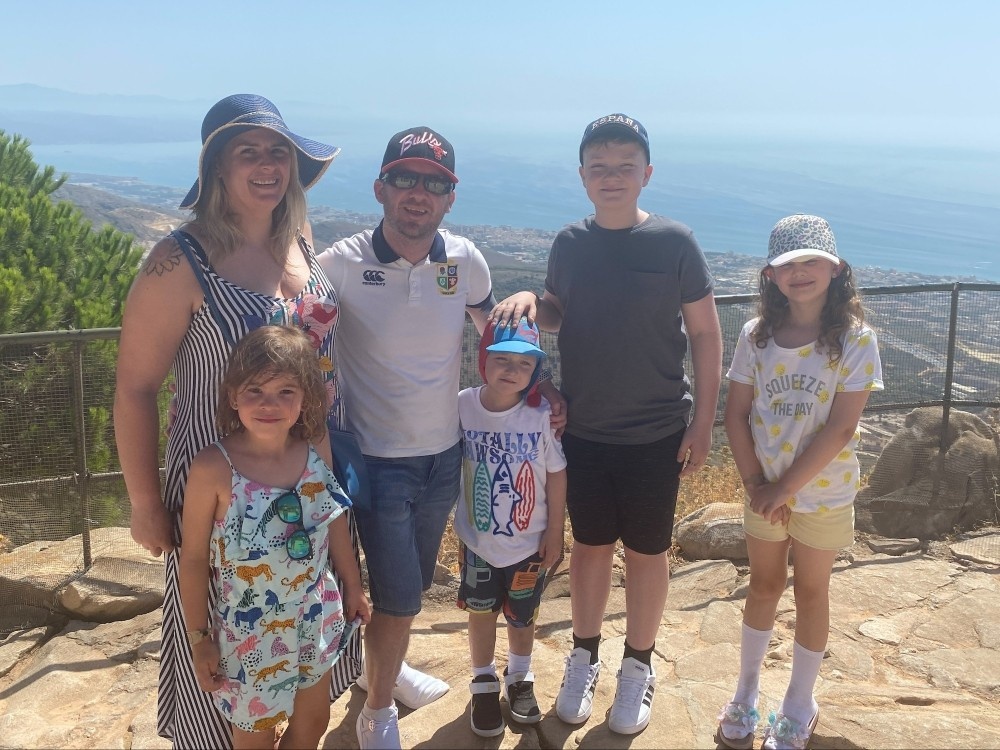
When you meet Robbie and Kara, one of the first things you notice is their warmth, their humour and the way they look out for each other. They’re parents to four children, dog-lovers and – before mitochondrial disease entered their lives – were constantly on the go. Their world was full of work, school, family, busy schedules and big plans.
But all that changed almost four years ago, when Robbie experienced what they thought was a stroke. What followed was months of fear, uncertainty and a gradual realisation that life as they knew it was gone.
The day everything changed
On Robbie’s 41st birthday, he woke up feeling ‘not quite right’. His vision was strange and he struggled just to get dressed. After a series of odd visual symptoms, Kara urged him to go to A&E. He went alone, Kara staying back with the children, both unaware of how serious things were about to become.
In the early hours of the next morning, Robbie rang Kara in tears. He couldn’t see. He couldn’t read. Kara dropped the children off at school and rushed straight to the hospital to see him, only to be stopped outside the ward because he was having a seizure.
“I don’t really remember much,” Robbie says. “Maybe mentally I don’t want to.”
Robbie stayed in hospital for over a week, struggling with aphasia – he was unable to even say his name or remember his date of birth – and frightened by the doctors’ uncertainty. The early suggestion was epilepsy; then simply a ‘strange stroke’.
The truth was far more complex.
A diagnosis they never expected
After Robbie returned home, a second seizure followed, and a second trip to A&E. He was finally seen by a specialist who suspected something unusual – mitochondrial disease. Tests began, though neither Robbie nor Kara truly understood what was being looked for.
When the results came back, they received the news in person. “It’s MELAS,” the doctor told them. “It’s a mitochondrial disease and it’s rare as hen’s teeth.”
“I didn’t have a clue what he was talking about,” Robbie admits. “I thought I’d had a stroke, and I was really scared. I didn’t understand any of it.”
For Kara, the confusion and worry set in immediately. Medical papers she found online were incomprehensible, and she didn’t know how to explain any of it to Robbie while he was still struggling with his cognitive ability.
That’s when she found The Lily Foundation.
Finding understanding and community
“The Lily Foundation website was the first place I found that explained mitochondrial disease in a way I could understand,” Kara says. “And the private Facebook group, being able to see other people’s stories, was a lifeline.”
Robbie and Kara eventually attended their first Lily Family Weekend, unsure what to expect. But the impact was immediate.
“It’s been so positive,” Robbie says. “Just talking to people who get it. People who don’t look at you blankly when you say ‘MELAS’. You can just have a normal conversation and have a laugh.”
Kara nods in agreement: “You don’t have to explain all the background. People already understand.”
That sense of community has become a source of strength for the couple, especially as they navigate the very real challenges of day-to-day life with a rare disease.
Adjusting to a new reality
Before his diagnosis, Robbie had always been independent, active and busy. He’d served in the Royal Navy, travelled the world, enjoyed a full-time, well-paid job in sales and marketing and drove a nice car. Losing his ability to work – and to drive – has been one of the hardest parts of his journey.
“It’s like losing your legs,” he says. “You lose your independence. Financially it’s been incredibly tough. And it’s hard emotionally too.”
Daily fatigue, anxiety, sensory overwhelm and periods of recovery mean their family life looks very different now. Planning is constant. Outings need to be carefully managed. What looks like a normal day out to others often takes an enormous toll behind the scenes.
But through it all, Robbie’s rebuilding – slowly, determinedly.
He’s begun coaching football again, started a podcast about men’s mental health and is preparing to retake his driving test after nearly four years off the road.
“The kids have been amazing,” he adds. “They’ve learned that sometimes Dad needs quiet or has to take it easy. They’ve adapted more than people realise.”
Despite the mitochondrial disease, life must carry on. There’s constant pressure from parenting challenges, financial strain and their youngest daughter’s recent autism diagnosis. They’ve had to grieve the life they used to have, while building a new one.
How The Lily Foundation stepped in
Alongside community support, Robbie and Kara talk openly about the practical and emotional impact of The Lily Foundation. Through Lily’s partnership with Rareminds, the couple were able to access professional counselling, both individually and as a couple.
“It gave us space to talk about things we didn’t know how to say,” Kara explains. “It helped us cope with everything we’d been carrying.”
Their team in Oxford have been a vital source of care, but Lily’s support has helped them navigate difficult periods and medical uncertainty. “There’s always someone to talk to,” Robbie says. “You feel remembered. Like you’re a person, not just a patient.”
When finances became overwhelming, the Lily Wish Fund helped them finish paying for their wedding reception, allowing them to celebrate their marriage after such a traumatic year. “It meant so much,” Kara says. “A moment of joy in the middle of everything.”
At their wedding, every guest received a Lily wristband as a favour, helping them raise awareness of mitochondrial disease among friends and family.
And Robbie and Kara have found their own ways to give back too. They ran a charity boxing show exclusively in aid of The Lily Foundation that raised thousands of pounds. Robbie regularly shares his story on social media and through his podcast to help others understand mitochondrial disease.
For them both, what makes The Lily Foundation stand out is something simple but profound – genuine care.
“Liz always makes time for everyone,” Kara says. “She remembers you. She listens. She cares.”
Robbie nods: “It feels comfortable. Like family.”
Moving forward with hope
Living with a rare disease is unpredictable. There are still questions without answers, and fears that can’t be fully resolved. But Robbie and Kara’s story is one of courage, adaptability and love – of finding a way forward even when the path is uncertain.
It’s also testament to the power of community, and the difference it makes to meet others who can understand and support.
“I still don’t fully understand MELAS”, Robbie shrugs. “But I know I’m not alone. And that makes everything a little less scary.”
Their story is also a reminder that there’s so much more still to be done. By donating today, you can help The Lily Foundation support families, drive research and change what it means to live with a rare disease. Together, we can ensure no one has to face mito alone.