
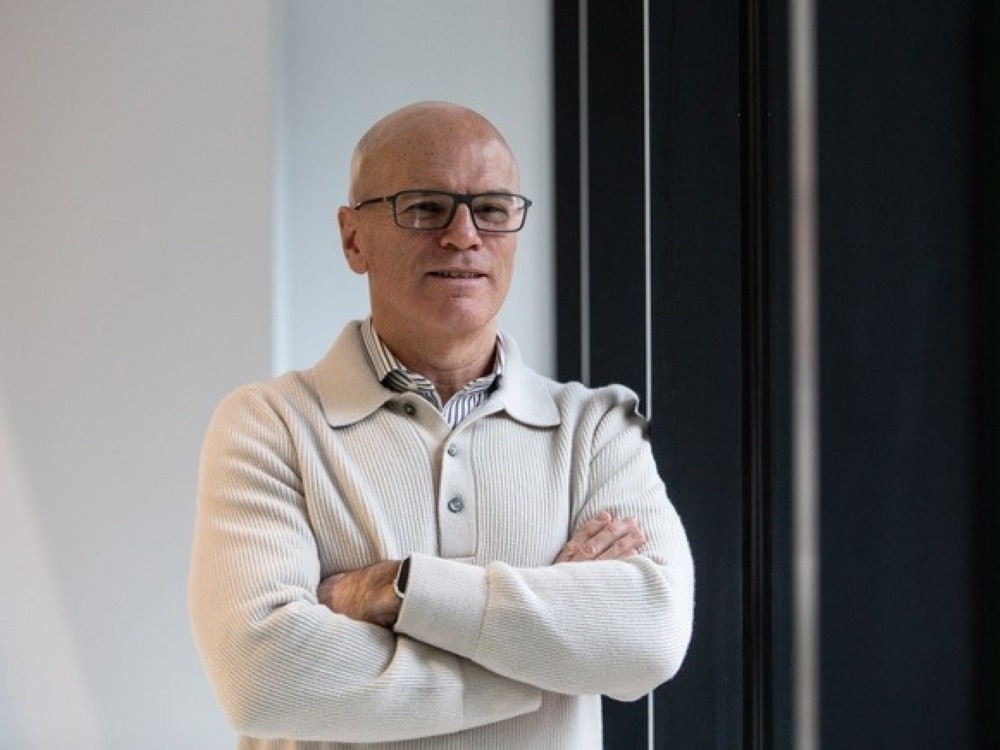
Prof. Bobby McFarland has recently been named on the 2026 TIME100 Health List, which recognises the world’s most influential leaders shaping the future of global health, including breakthroughs in research, treatment and policy.
As a valued member of our Medical Board at The Lily Foundation, Bobby’s played a pivotal role in advancing understanding, diagnosis and care for people affected by mitochondrial disease. We sat down with him in the wake of this achievement to understand what it really means for him, and for the wider mito community.
Bobby was quick to shift the spotlight away from himself as soon as he began to speak about it. “This is the culmination of a huge team effort over many years,” he said. “It’s really an award for the team rather than for me personally. There have been many people before me who’ve contributed enormous amounts too, so that’s important to say.”
For a condition that remains widely under-recognised, this global recognition represents something much bigger. “Mitochondria is on that list now,” he explained. “That’s fantastic for the patient community because it’s about profile and understanding. People will start to ask, ‘What is mitochondrial disease, and why does it matter?’”
Raising awareness is critical in rare diseases, particularly when it comes to driving funding, influencing policy and accelerating research. Recognition at this level places mitochondrial disease firmly on the global health agenda.
From chance beginnings to pioneering progress
Bobby’s journey into mitochondrial medicine began, in his own words, “a bit by chance”. After moving from London to Newcastle early in his career to complete his training in paediatrics, he was encouraged to pursue laboratory-based research, a decision that would shape decades of work bridging science and patient care. That early research led to a breakthrough publication and sparked what he describes as “getting the bug” for mitochondrial science.
In 2000 he completed his entry-level fellowship and had a paper published in Nature Genetics. “It was that publication that put me on the route to my research,” he recalled, “and allowed me to get a full fellowship with clinical training.”
Since then, his career has spanned both laboratory discovery and clinical innovation, always rooted in improving outcomes for patients and families. It was in those early clinic days, seeing parents arrive with children who were failing to thrive, that sparked his determination to develop the paediatric clinic where he’s still driving progress today.
Transforming what’s possible
Among the most significant milestones in his career are the advances in preventing mitochondrial disease. Bobby played a key role in developing reproductive options such as pre-implantation genetic testing (PGT), with the birth of the first baby through this approach marking a turning point.
“We started the clinic in 2011 and the first baby was born in 2012. That was the moment we were actually doing something to prevent disease. We didn't really shout from the rooftops but in terms of a program of care, essentially that was the model that we have now for mitochondrial donation.”
He’s also been closely involved in the development of mitochondrial donation, a groundbreaking IVF technique that’s offered new hope to families affected by inherited mitochondrial conditions.
“Of course, last summer the New England Journal papers were the culmination of a huge effort,” he said. “That represented 20 years of hard work, a lot of negotiation and even a bit of political wrangling!”
And the publicity surrounding that news was just as impactful as the news itself. “Talk about raising awareness! It was fantastic for our community, being interviewed by the BBC, Sky, CNN… It was an amazing time. What more could we ask for in terms of awareness than to be the lead story on the News at Ten?”
The power of community
Bobby emphasised how patients and families have been central to progress throughout his career. “Listening to patients and bringing that back to research is what a clinical academic role is all about,” he explained. “That’s what makes it so fulfilling, helping to push things forward and get answers and treatments – and prevention, as with mitochondrial donation and PGT.”
He also highlighted the importance of collaboration, both internationally and with patient organisations like The Lily Foundation, whose role in shaping research priorities and supporting families continues to grow.
“I've seen Lily grow from a relatively small organisation to an intermediate charity,” he said. “The fact that you’re now part of the LifeArc Centre for Rare Mitochondrial Diseases, actually an equal partner, that speaks volumes.”
“Hopefully I'm able to offer something to Lily, and to the community. I've got several distinct roles with the charity: as an expert medical adviser, as an advisor around the direction of the charity and finally as a critical peer reviewer of research applications. There are benefits to me for being in those roles as well.”
He’s constantly impressed by the strength of the patient community and how willing mitochondrial disease patients and their families are to be involved in research.
“That’s immensely helpful in bringing in funding and recruitment, but it was also key to changing the law around mitochondrial donation, for example. We ran focus groups with The Lily Foundation on how we might deliver the follow-up for mitochondrial donation and I still use the outcomes of those focus groups when I’m talking about it today.”
A field on the cusp of treatment breakthroughs
While prevention has advanced significantly, treatment has historically lagged behind. That’s now beginning to change.
“It’s an exciting time now I believe we’re on the cusp of being able to treat these conditions,” he said. “We’ve got a treatment for LHON now in terms of idebenone. Gene therapy trials are progressing. If you’d told me 10 years ago we’d have a phase three clinical trial, I’d have said that’s amazing.”
What encourages him most is that momentum is gathering on several fronts, with numerous drug companies developing potential treatments, excellent research happening and new technologies available beyond whole genome sequencing.
“We've got transcriptomics and proteomics that are really helping to identify diagnostically but also to understand the mechanisms that are causing disease,” he explained. “We’re on the upstroke of that curve, and there’s now a realistic prospect of treatments.”
And with advances in genetics, data science and emerging technologies such as AI, the pace of discovery is accelerating. Looking ahead, one of the most ambitious developments is the imminent creation of the UK Mitochondrial Disease Research Institute, driven by The Lily Foundation and a major step forward.
“We need the infrastructure to deliver treatments,” he explained. “We need patient registries and biobanks, and we need trained clinicians and researchers coming through the system when I’m wearing my slippers and smoking a pipe! This is what Lily have been saying for a long time now, and this is why The Institute will exist – to bring these elements together, ensuring the UK is ready not just to develop treatments, but to deliver them to patients.”
Hope for the next decade
Despite all the challenges and complexities of mitochondrial diseases, Bobby’s clear about the direction of travel.
“The biggest challenge is a treatment – because it won't be one treatment. There will be treatments for specific diseases, and there may be generic treatments out there too, things that improve mitochondrial function and limit mitochondrial damage to cells. What we as clinicians will end up doing is prescribing a combination of both.”
The quest for treatments is further complicated by the fact that new diseases are still being discovered. “I had an email this morning from a prominent researcher in the UK saying they think they’ve found a new form of mitochondrial disease and a new gene that’s causing it,” he explained.
“These days I open many of my talks by saying it’s not ‘mitochondrial disease’, it’s ‘mitochondrial diseases’ – an umbrella term for over 350 different diseases. To treat and cure all of those is a huge ask. But if you can start picking them off one by one or in groups, it becomes more feasible.”
Ultimately, he feels confident that the future for mitochondrial disease research is bright. “It’s an exciting time to be in the field because I think there's more than just a glimmer of hope now. It’s hope that’s always kept people going. But now I think there’s a realistic prospect which wasn’t there before.”
Bobby’s right – there is hope. His leadership, dedication and groundbreaking work continue to drive progress and bring hope to families across the mitochondrial community. And his recognition by TIME100 is testament not only to his outstanding contribution to global health, but also to the importance of continued research and collaboration in the field of mitochondrial disease.