
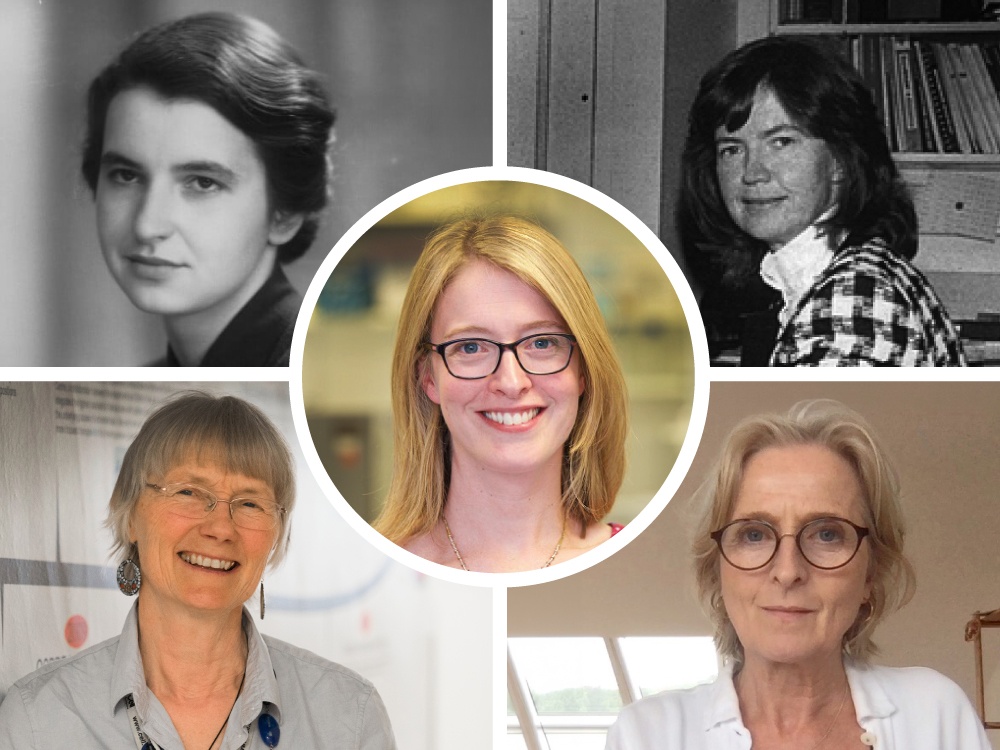
Rosalind Franklin
Laying the foundations
In 1952, Rosalind Franklin produced an X-ray image known as Photo 51. That image revealed the structure of DNA – the blueprint for life.
Without understanding DNA, there would be no genetic testing and no way to identify the changes in mitochondrial DNA that cause inherited mitochondrial diseases. Every diagnosis reached today builds on the foundations she helped establish.
(Rosalind Franklin image by Elliott & Fry half-plate film negative, 11 June 1946. NPG x76929 © National Portrait Gallery, London)
Anita Harding
Recognising mitochondrial disease
By the 1980s, scientists were beginning to understand that mitochondria have their own DNA. Anita Harding helped prove that faults in mitochondrial DNA could directly cause serious neurological disease.
Her work identified some of the first mitochondrial DNA mutations linked to human illness. This was a turning point, confirming that mitochondrial disease was genetic, diagnosable and worthy of focused research.
For many families, this marked the beginning of clearer answers.
Joanna Poulton
Understanding inheritance
Mitochondrial DNA is inherited solely from our mothers, but the way mutations are passed on in mitochondrial diseases can be complex and unpredictable.
Professor Jo Poulton’s research has been instrumental in explaining how mitochondrial DNA mutations are transmitted from mother to child and why symptoms can vary so widely, even within families.
Her work has helped shape genetic counselling and supported families in making informed decisions about the future.
Mary Herbert
Preventing transmission
Professor Mary Herbert has been central to the development of mitochondrial donation techniques.
These pioneering approaches aim to prevent certain inherited mitochondrial DNA mutations from being passed on to the next generation. In 2015, the UK became the first country in the world to regulate mitochondrial donation IVF, and last July we were delighted to share the groundbreaking news that eight healthy babies had been born via the technique, with no signs of mitochondrial disease.
Mary’s work represents a remarkable shift, moving from simply understanding disease to actively working to prevent it, and offers hope to some families affected by inherited mitochondrial diseases.
Sarah Pickett
Powering progress today
Progress in mitochondrial medicine shows no sign of slowing down. Dr Sarah Pickett, a Wellcome Career Re-entry Fellow at Newcastle University, is working to understand why people with the same mitochondrial DNA mutation can experience very different symptoms.
Her research focuses on the molecular mechanisms that influence how mitochondrial disease presents, knowledge that’s essential for improving diagnosis, predicting outcomes and developing more personalised approaches to care.
After taking an extended career break to raise her family, Sarah returned to research in 2015 through a competitive fellowship programme. Her journey highlights both the challenges and the resilience involved in building a scientific career, particularly when balancing research with family life.
Researchers like her represent the next chapter in mitochondrial medicine. They’re building on decades of discovery whilst working to answer the complex questions that still face families today.
From past discovery to future hope
From revealing the structure of DNA to identifying mitochondrial mutations and preventing transmission, women have helped shape every stage of progress in mitochondrial medicine.
Their work lives on in laboratories and clinics across the UK and beyond, inspiring current and future generations to explore new treatments and break new ground. It lives on in earlier diagnoses, deeper understanding of mitochondrial diseases and growing hope for those families affected.
Progress is powered by people. And many of those people are women. This International Women’s Day, we’re celebrating the female pioneers of the past as well as the scientists who are shaping the future.