
DNA might be tiny, but it tells the story of who we are.
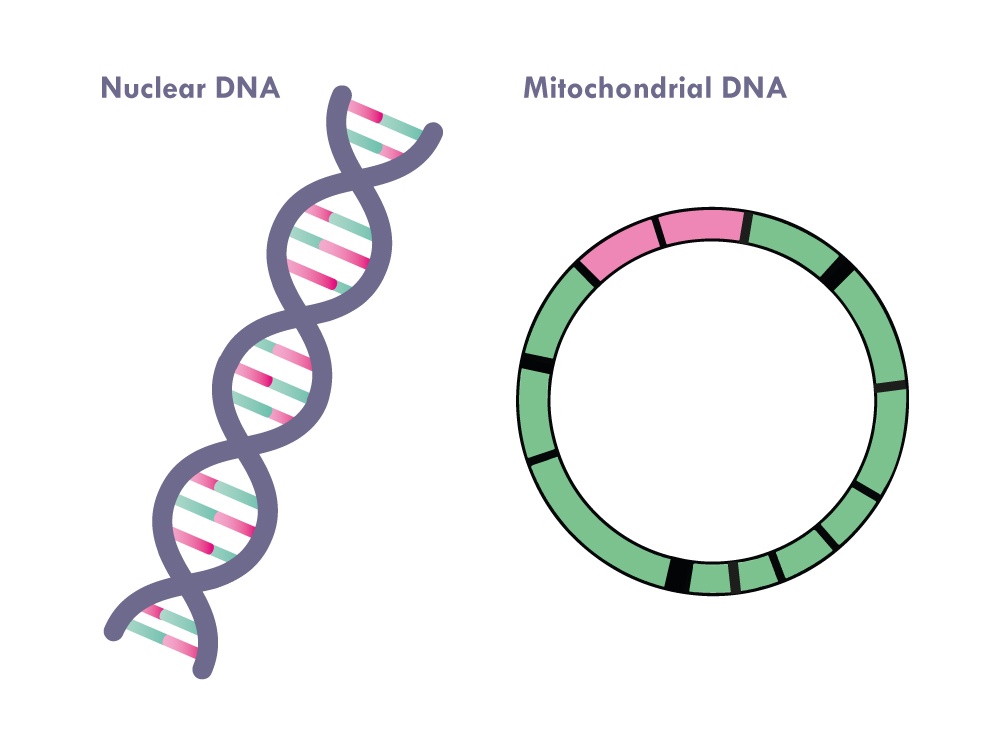
Many people don’t realise that we all actually have two different types of DNA in our bodies. We’re all familiar with nuclear DNA which looks like a twisting ladder and makes up 99.9% of the total DNA in our bodies. It’s responsible for determining all the unique characteristics that make us who we are.
Slightly less familiar is mitochondrial DNA, which is a tiny ring-shaped structure. It plays no part in determining our unique characteristics but is crucial for the production of our energy.
Our nuclear DNA contains over 20,000 genes whereas our mitochondrial DNA only contains 37 – although it’s small, we couldn’t live without it!
What is nuclear DNA?
Nuclear DNA is found within the nucleus of our cells. It’s linear in shape and makes up 99.9% of the total DNA in our body.
Within the cell, the nuclear DNA is packaged up into structures called chromosomes. Humans have 46 chromosomes per cell which are arranged in pairs (23 of these come from your mother and 23 from your father). These chromosomes contain between 20,000 to 25,000 genes.
Nuclear DNA (and the genes that it holds) is responsible for providing the basis for how human bodies are built and work, as well as determining all our characteristics.
What is mitochondrial DNA?
This is a special circular type of DNA that’s only found within the mitochondria themselves and it makes up only 0.1% of the total DNA in our bodies.
Mitochondrial DNA contains only 37 genes, all of which are essential for normal mitochondrial function (13 of these genes provide instructions for making enzymes involved in the Electron Transport Chain and the remaining genes provide instructions for making molecules which help put proteins together).
Mitochondrial DNA is inherited only from your mother (as the father’s mtDNA is destroyed during fertilisation). Humans contain between 100-1000 copies of mitochondrial DNA per cell.
So DNA might be tiny, but it has a huge impact on how our bodies work. And on conditions like mitochondrial disease.
That’s why DNA matters.