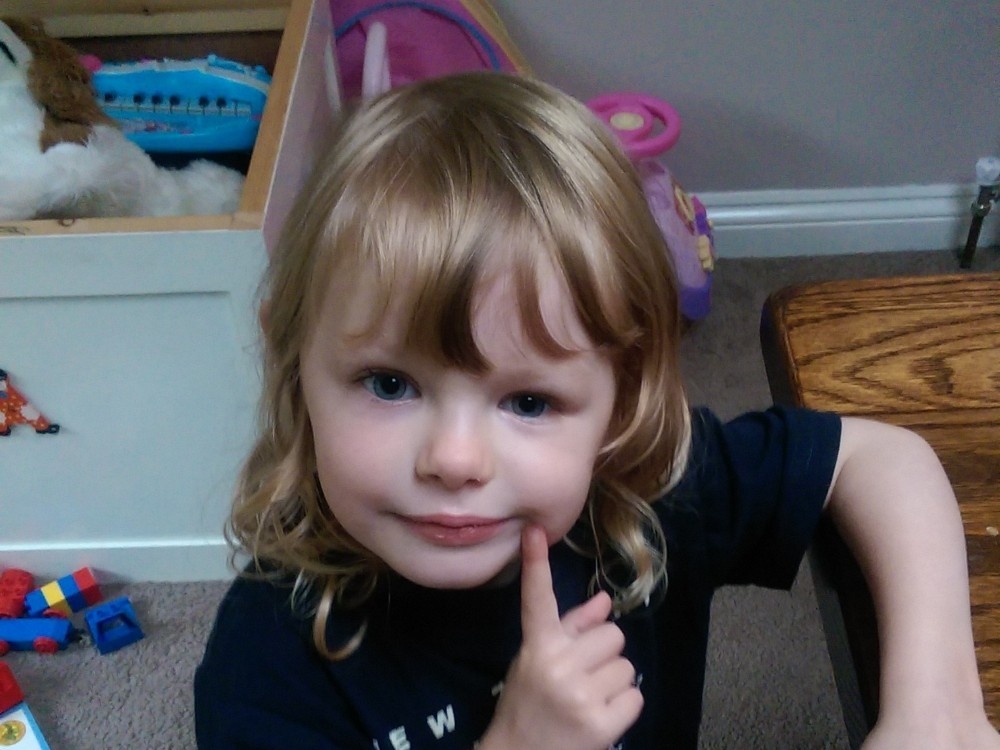
“When people ask how many children I have, I always say two,” says Liz. “There’s Chloe, who’s 11, and there’s Keira, who will always be part of our family. She’s forever five.”
“There are so many different things to remember,” she smiles, reflecting on her daughter’s short but very special life. “It’s hard to say what she loved most because it changed every day, But she was obsessed with Disney’s Tangled. That was our go-to film – if she wasn’t feeling well, if she needed cheering up, even on a lazy Sunday. I must’ve watched it a million times.”
Before illness became part of their lives, Keira was a typical, energetic little girl. She loved her trampoline, swimming and playing outside in the mud. Her favourite food was McDonald’s chicken nuggets and she was, quite simply, lovely.
A beginning like any other
Keira’s start in life appeared normal. Liz’s pregnancy had its complications – low fluid levels and a breech position – so she was delivered via a planned C-section.
“When she arrived,” Liz recalls, “she was perfect. She had two arms, two legs, 10 fingers, 10 toes and she was absolutely beautiful.”
As she grew, Keira reached some milestones later than expected. She bum-shuffled rather than crawled and didn’t begin walking until around 16 to 18 months. But as first-time parents, Liz and Lee had nothing to compare it to – they were simply learning as they went.
There were illnesses early on. Periods of sickness led to hospital stays, feeding tubes and worry. But at the time, they believed these were the everyday bugs and infections she would recover from.
But everything changed when Keira was three years and three months old.
When life changes in an instant
Keira’s first seizure came without warning. She was rushed to A&E in Basingstoke, where doctors initially treated her for viral meningitis. Within hours, she was transferred to intensive care at Southampton Hospital.
More seizures followed. More tests. Then Keira lost her vision.
“They took everything from her little body,” Liz recalls. “Blood, urine, lumbar puncture, muscle biopsy, skin biopsy, you name it.”
Eventually, Liz and Lee were called into a small room at the hospital.
“They told us it was Alpers-Huttenlocher syndrome, which is a type of mitochondrial disease,” says Liz. “I couldn’t even pronounce it, let alone understand what it meant.”
What followed was a blur of clinical terms and devastating realities: brain damage, kidney failure, liver failure, life-limiting illness.
In that moment, everything changed. Liz and Lee were faced with something no parent should ever have to comprehend – that at some point, in the not-too-distant future, they were going to lose their child.
Living with the unknown
From that point on, life became about more than just managing Keira’s condition. It became about living with the knowledge that time was limited.
“No two cases of mitochondrial disease are the same,” Liz explains. “We tried looking things up on the internet, but every story seemed worse than the last.”
Keira’s condition progressed. Her seizures became continuous. Gradually, she lost her mobility and her ability to swallow.
By February 2016, the family were told she didn’t have long.
So they stopped waiting. They stopped planning. They just lived.
“We just did what felt right,” says Liz. “Some days we’d go out, some days we’d stay in the house in our pyjamas. None of the normal stuff mattered anymore.”
Saying goodbye
In July, they went to Naomi House, a children’s hospice, for what was meant to be a short respite break. They’d been hearing ‘not long’ for months, but this time felt different.
A doctor gently explained that Keira likely had hours left, or at most a week.
They called their families. Everyone came and filled Keira’s room with love, laughter and even moments of joy. The family made a conscious decision: no tears that day. They wanted it to be peaceful for Keira.
Later, as Liz cared for her daughter, she noticed her movements slowing. She knew.
Keira’s parents held her close and said goodbye in their own way, surrounded by love and dignity, exactly as they’d hoped.
Keira’s legacy ten years on
Grief doesn’t end. It changes.
“We have good days and bad days,” Liz reflects. “Every anniversary hurts, but this one… this is the decade, it’s a big milestone. There will be tears, and a lot of reflection. But we’ll make a day of it – we’ll do something to really embrace it.”
Chloe, Keira’s younger sister, was just shy of two when Keira passed away. Her understanding of loss has grown as she has. But time hasn’t made it any easier.
“Even now, she’ll come in and say, ‘I just miss Keira,’ and burst into tears,” Liz says. “As a bereaved parent, it’s harder in some ways when you have another child, because you’re trying to cope with their grief as well as your own.”
And that grief extends even further – to grandparents, aunts and uncles, nephews and nieces, cousins, friends.
“It touches everyone,” she adds. “How do they cope? How do you cope?”
Keeping Keira’s memory alive
Over the years, the family have found ways to channel their grief into something positive through Team Keira.
“At the start, it was about giving people something to do,” Liz explains. “A friend said she felt so helpless – and the next thing we knew, we were cycling from London to Brighton to raise funds for The Lily Foundation.”
Chloe now plays a big role in keeping her sister’s memory alive. Each year, she finds her own way to mark Keira’s birthday.
“When Keira would have turned 13, Chloe ran a half marathon around the village,” Liz adds. “This year, she held a plant sale outside the house and raised £500.”
“She’s done so well. She always wants to do something different – the wackier the better, I say. She’s talking about doing a skydive next, but we’ll have to wait until she’s old enough for that.”
What bereaved parents need you to know
Bereaved Parents Day is about acknowledging a truth many people find difficult to talk about.
“If you don’t know what to say, just ask,” says Liz. “People are often too afraid of saying the wrong thing, so they say nothing at all. But it’s okay to ask – it really is.”
There are also things she gently encourages people not to say.
“‘I don’t know how you do it,’ or ‘You’re so strong, I couldn’t cope in your situation’. I didn’t have a choice. I just had to get on with it.”
“No parent should have to bury their child. Unless you’ve been through it, you can’t fully understand. We’ve all lost somebody we love, but losing a child is different. It goes against the natural order of things. When you lose a child, it’s a different kind of grief. One that never leaves you.”
And yet, alongside that grief, there’s love. Constant, enduring love. Today, tomorrow and forever.
Light a candle, honour their memory
On Bereaved Parents Day, we invite you to pause and remember children just like Keira who are deeply loved and forever missed by lighting a candle in their memory. A simple yet powerful way to honour the memory of a special child and help ensure that no one has to face mito alone.