
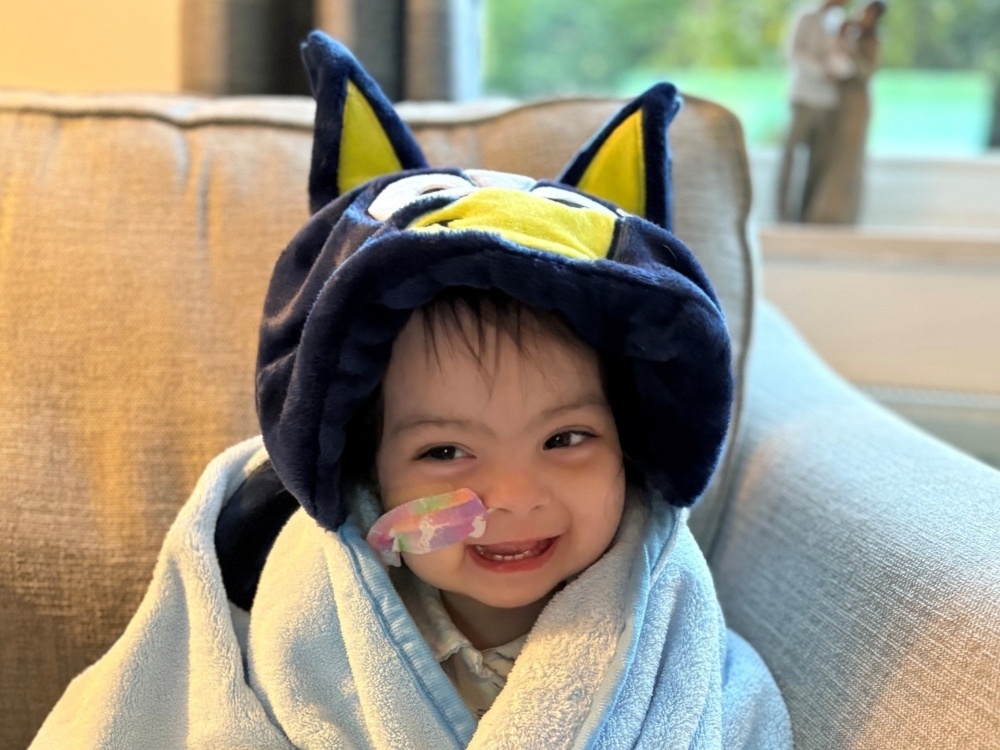
Aria was a bright, determined little girl whose smile lit up every room she entered. Her parents, Terry and Pooja, describe her as ‘headstrong but very, very lovable’, and their memories of her are filled with huge smiles, nursery rhymes and the infectious joy she brought to those around her.
Despite facing immense challenges, Aria was curious, clever and full of personality, quickly mastering new toys, charming everyone she met and dancing with delight whenever the Bluey theme tune started playing.
But behind that infectious joy, Aria was facing a series of unexplained health problems. From birth, she struggled with feeding difficulties and on several occasions was admitted to hospital with low blood sugar and infections she didn’t bounce back from. As her health deteriorated and the hospital stays increased, doctors initially investigated liver problems, before the onset of a series of seizures and a rapid genetic test finally revealed the answer.
At just 16 months old, Aria was diagnosed with POLG-related mitochondrial disease, a rare genetic condition that affects the body’s ability to produce energy. She’d inherited one faulty gene from her dad and another from her mum – a devastating genetic combination resulting from extraordinarily rare odds.
Her parents were told there was no cure and that Aria wouldn’t make it to her teens; indeed, her doctors expressed surprise that she’d made it as far as she had. Terry and Pooja recall feeling like their lives had been shattered, as if everything they’d hoped and dreamed of was being snatched away.
Determined to make the most of whatever time they had left together, they focused on creating memories and giving Aria as much joy as possible. She continued to surprise those around her with her resilience and strength, recovering from setbacks that many thought she wouldn’t overcome.
But in the end Aria became too poorly to be looked after at her local hospital in Cumbria and was transferred to the Royal Manchester Children’s Hospital. Terry and Pooja researched everything they could about POLG-related mitochondrial disease and fought for every possible treatment for their daughter. She underwent numerous tests, MRI and EEG, and gave so much blood she was black and blue, all to no avail.
Aria died at Francis House Children’s Hospice exactly one year ago, on 9th August 2025, aged just 20 months. But the awareness and fundraising campaign Terry and Pooja began during her lifetime has grown into Team Ari-Boo – a lasting legacy dedicated to raising awareness of mitochondrial disease and creating positive change in her memory.
Building Team Ari-Boo
A nurse in ICU once tied Aria’s curls into pigtails and said she looked just like Boo from Monsters, Inc. From that day on, she became known as ‘Ari-Boo’, so when it came to naming their fundraising team, it was a no-brainer.
But for Pooja and Terry, Team Ari-Boo was never just about raising money. It began as a way of ensuring that no other family facing mitochondrial disease would feel as alone and lost for answers as they had.
When Aria was diagnosed, they struggled to find other local families navigating the condition and were often faced with a lack of awareness about mitochondrial disease. By sharing her story publicly, Terry and Pooja hoped to shine a light on a rare condition and provide a point of contact for families who might be searching for answers.
“We felt so alone in our journey,” said Pooja. “There was nobody else we could connect with in Cumbria, and even our local hospital knew very little about the condition. We wanted Aria’s story to be there so that if somebody else started seeing similar symptoms in their child, they might recognise something and know there’s somewhere they can reach out to.”
The couple initially set up a Facebook page in support of The Lily Foundation but were in two minds about what to do. “Neither of us had ever done any fundraising before,” recalls Terry. “I’d entered a few local events but never for a specific charity.”
So they signed up for the Alton Towers Half Marathon, thinking it would be a great way to raise awareness of mitochondrial disease. They set up a JustGiving page with a target of £500, and within the first hour it was over £1,000.
As the support grew, so did their ambitions, eventually leading Terry to sign up for the London Marathon, along with Aria’s uncle, despite having never run a marathon before.
“It was a case of go big or go home,” laughs Terry. “It was never the goal to run the marathon, but I thought maybe this is our chance, and what a great opportunity it could be.”
Along the way, Team Ari-Boo has become much more than a fundraiser. Through sharing their experiences, the family connected with people who have faced similar losses and rare diagnoses, discovering a community they never knew existed.
“The amount of people who reached out was incredible,” Terry said. “People who had lost children, people affected by mitochondrial disease. We never would have met those people if we hadn’t started sharing Aria’s story.”
Today, Team Ari-Boo’s legacy continues in different ways.
Terry still runs in Aria’s memory, carrying a promise he made after completing the London Marathon.
“I haven’t stopped running,” he says, “because I took it up for Aria. The one thing I think of whenever any run gets hard is that she managed to breathe, despite everything she was going through. If she could do it, then there’s no excuse for me.”
For Pooja, the experience inspired her to address another gap she encountered after losing Aria. She’s since established a bereaved parents’ support group through a local hospice, creating a space for families who, like her, were searching for understanding and connection.
“Starting Team Ari-Boo has inspired us to venture off into our own specific areas,” she explains. “My group’s been running since April now, and we meet once a month. It’s so rewarding, I just have no words for it. I’m speechless.”
Together, they’re also exploring ways Team Ari-Boo can continue supporting local services and raising awareness of mitochondrial disease closer to home. After Aria’s diagnosis, they saw clearly the discrepancy between care at their local hospital and that provided in bigger cities.
For them, that’s what Aria’s legacy is all about – identifying the gaps they experienced and helping make the path a little easier for the families who come after them.
We’ll leave the final word to Aria’s mum, Pooja: “Before Aria, I never realised how extraordinary the ordinary could be. A family walk. A spoonful of ice cream. A moment without sickness. Those tiny victories became our greatest celebrations. If there’s one thing I’d want people to take away from her story, it’s to cherish the little things, because they often become the moments that matter most.”
And perhaps that’s the true measure of Aria’s legacy – not just the funds raised or the services created, but the lives touched along the way.
From tiny acorns grow great oak trees. What started as a tribute to one remarkable little girl has become a source of strength for countless families, helping to ensure that no one has to face mitochondrial disease alone.